
Rice sustains more than 3.5 billion people, nearly half the world's population, and close to 90% of the world's rice is grown and consumed within Asia. The grain underwrites food security and the livelihoods of millions of farming families across the region, a dependency that leaves little room to simply grow less of it.
Cultivation carries a heavy environmental cost of its own. Food, agriculture and land use already account for 54% of Southeast Asia's greenhouse gas emissions, and rice alone contributes close to a third of the region's methane, a gas that traps roughly 30 times more heat than carbon dioxide. With demand projected to rise by around 30% by 2050, the pressure sits on how rice is grown.
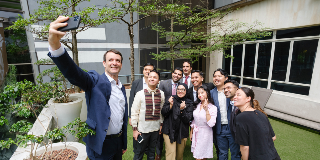
That challenge brought the Philanthropy Asia Alliance (PAA) team to Grobogan in Central Java earlier this year, to see how the Decarbonising Rice initiative, developed by the Temasek Life Sciences Laboratory (TLL) with support from PAA and its members, is testing whether science can grow rice with less emissions and less water, without giving up yield.
Walking the fields
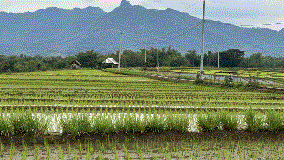
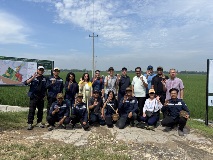
The first impression in Grobogan is how ordinary it all looks. Paddies stretch across the landscape much as they have for generations, giving little sign that this is one of three sites where TLL is testing an approach that forms part of a wider industry effort to change how rice is grown across Asia.

TLL’s particular approach combines three elements: climate-resilient rice varieties, improved water management, and more precise nutrient application. Early trials in Singapore and India cut methane emissions and water use by 30 to 50% while lifting yields by 5 to 10%, and in India, pairing drip irrigation with TLL's fertiliser regime pushed methane reductions as high as 70%.
PAA first backed the project at the Philanthropy Asia Summit in 2023, helping close the funding gap needed to move it from small plots into the 100-hectare pilots now running in India, Indonesia and Laos, with the current phase expected to run till 2027. In Indonesia, the first 100-hectare trial, spanning around 170 smallholder farms, has produced results consistent with the earlier trials, and a second is now underway.

For Dr Srinivasan Ramachandran, TLL's senior principal investigator, the harder challenge is rarely the science itself. "When you try to introduce something scientifically proven, the farmers are hesitant, and they worry about the yield," he says. "Our responsibility is to teach them and then show that this works better. In Indonesia and in India, people have seen what we are doing, and now they are ready to adapt as well."
That confidence builds gradually. Farmers watch a neighbour's field, compare harvests at the end of a season, and decide for themselves whether the new approach is worth the risk. Rize, TLL’s local partner who leads the farmer engagement and implementation on the ground, draws on its existing network of partnerships across Java to help build trust with farmers. One successful plot tends to lead to another, though the pattern rarely travels much beyond a village on its own. Turning that local proof into a regional practice is the harder task, and the one PAA is trying to solve.
Beyond the pilot

Many promising agricultural innovations show strong results on a handful of farms, then struggle to reach more than a few thousand hectares. The barrier is not a shortage of solutions. Across Asia, multiple approaches – including TLL’s – have already shown that rice can be grown with lower emissions, less water, and better yields. The task now is not to scale a single methodology, but to bring together a range of proven interventions that can work across different farming, economy and environmental contexts. Only when markets, governments and capital can move together, the needed scale to outpace current emissions can be achieved.
Farmers need confidence that changing an established practice will not cost them a season's income, which is where patient, early-stage funding does work commercial capital will not. Governments shape the ground through agricultural policies and procurement systems, and sustainable practice tends to spread only as far as it gets woven into those systems rather than sitting apart from them. Buyers, meanwhile, need assurance that low-emission rice can be supplied consistently, at a quality and price they can commit to, before they will shift a supply chain to it.
PAA's own contribution is to identify priority markets and convene the governments, funders and buyers who need to move together, while testing financing models that can carry farmers through the adoption period. This is not limited to scaling any single model, but to supporting a range of proven approaches that can be applied across different contexts. The ambition is to bring five million hectares of rice under improved management by 2030.
The pilot trials are opening up opportunities that extend well beyond emissions reduction. Carbon credits generated through these practices could become a second income stream for the farmers who took on the early risk. This is work that Rize, the local partner is helping to bring to market. This points to a more systemic way of tackling the rice challenge, one where the gains reach farmers' livelihoods as much as they reduce emissions.
From field to market

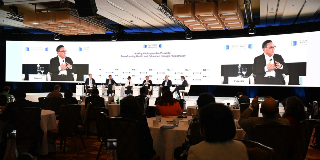
Shaun Seow, PAA's CEO, pointed to that test of the market during an interview with CNA in Semarang. "The proof of the pudding is in the eating. Will the price point be similar? Will it taste as good as traditionally grown rice? That is the end game for all of us at the Alliance," he said.
PAA is working with partners to help build that market. As the regional anchor partner for the World Economic Forum's First Movers Coalition for Food, it is bringing governments, buyers, philanthropies and delivery partners together to help move solutions like this one past the field and into supply chains that can carry them at scale.
Grobogan showed what disciplined science can do on a single trial plot. Whether that result becomes the norm across Asia's rice belt depends on how well policy, finance and demand move together from here, work that will take years, not seasons, to prove out.
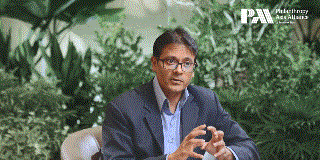
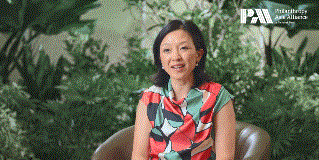
WATCH: Hear the voices driving the Decarbonising Rice initiative and where they are headed towards





.tmb-.gif?Culture=en&sfvrsn=e13997ec_1)
.tmb-.gif?Culture=en&sfvrsn=b5ece239_1)
.tmb-.gif?Culture=en&sfvrsn=6fb3b6df_1)
.tmb-.png?Culture=en&sfvrsn=7fea9931_1)
.tmb-.gif?Culture=en&sfvrsn=3f4b1163_1)
.tmb-.jpg?Culture=en&sfvrsn=fedc60fc_1)