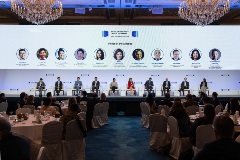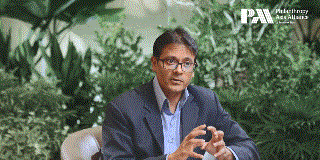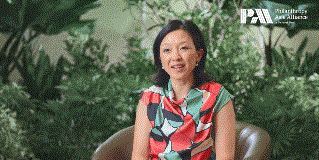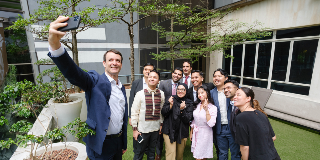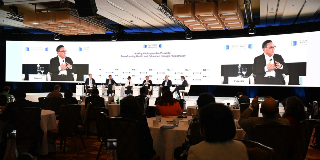
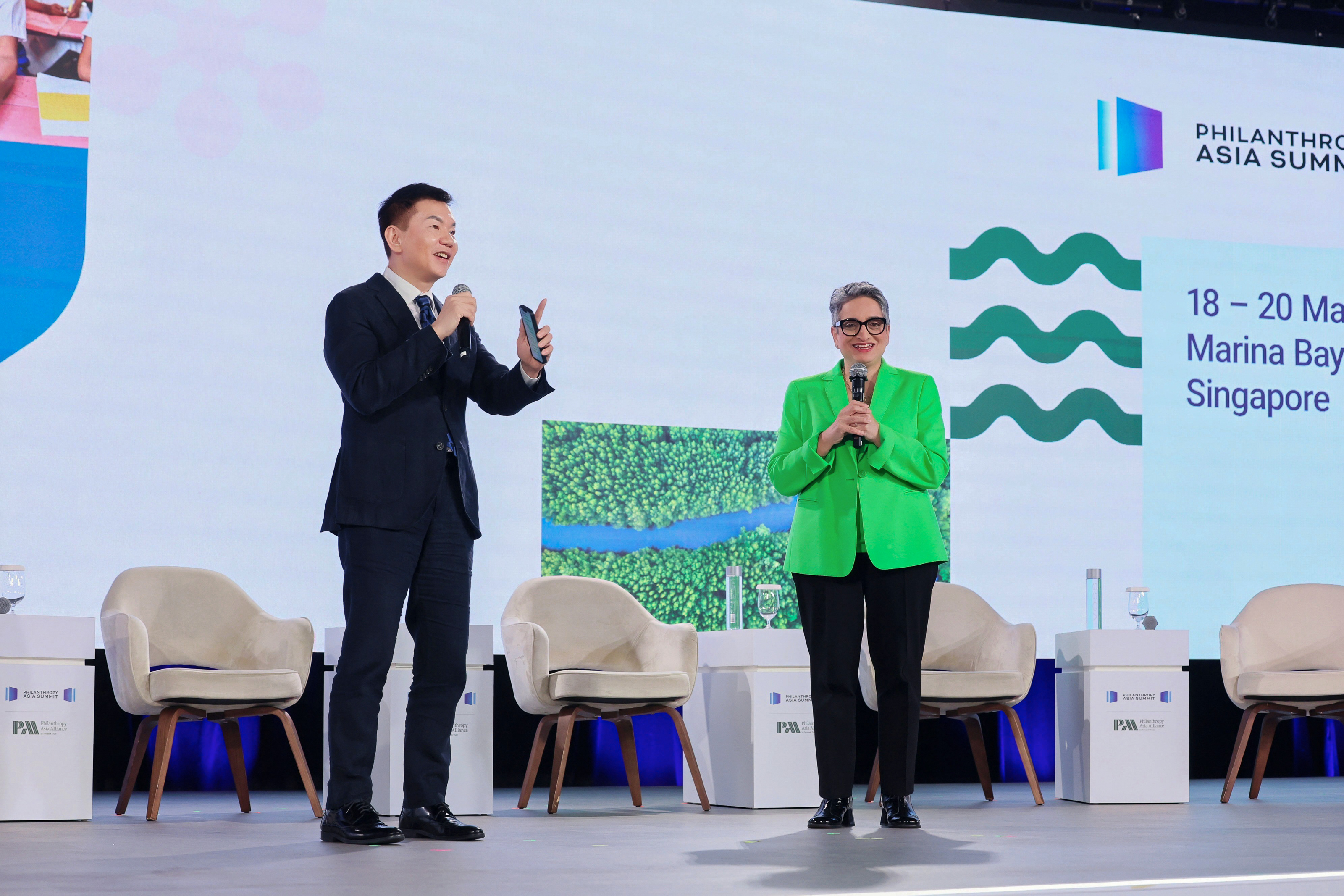
Announced by Shaun Seow, CEO of Philanthropy Asia Alliance, and Shamina Singh, President of the Mastercard Center for Inclusive Growth, during the Philanthropy Asia Summit 2026 in May, the partnership connects evidence generation with philanthropic capital and regional networks to advance inclusive economic participation for small businesses and digital economies across Asia.
Across Asia, digital financial services have expanded rapidly. Yet greater access does not always lead to stronger financial health, business resilience or long-term economic opportunity. Micro and small businesses can open accounts, connect to platforms and receive digital payments. Many still face income volatility, debt stress and platform dependency that leaves them more exposed, not less.
Philanthropy Asia Alliance (PAA) and the Mastercard Center for Inclusive Growth (the Center) have formalised a three-year partnership to help close that gap. The collaboration connects the Center's regional research portfolio with PAA's convening power, member networks and capital mobilisation capability, creating a structured pathway from insight generation to ecosystem influence and pilot action.
Connecting two complementary capabilities
The Center has built a substantial body of work on financial health, small business growth and tech for good across Asia through partnerships with regional institutions and ecosystem actors. PAA, through its Inclusive Development pillar, mobilises philanthropic capital and platforms to support broad-based economic participation and resilience across the region. On their own, each is consequential. Together, they bring something the sector has long needed: a working link between research and implementation.
Two complementary pathways shape the collaboration. Through joint amplification, PAA will work with the Center to position and share findings through summits, closed-door policy discussions and multi-stakeholder convenings, bringing evidence into conversations among policymakers, financial institutions and philanthropic actors. Through capital mobilisation and solution development, PAA and its members can take selected insights forward into pilot design, philanthropic funding and implementation where findings demonstrate strong evidence and ecosystem readiness.
Neither pathway is fixed. The collaboration is structured as a flexible platform, allowing priorities to evolve as regional needs shift and new evidence emerges. A joint steering committee, meeting at least twice annually, will oversee progress and strategic alignment between the two organisations.
Shaun Seow, Chief Executive Officer of Philanthropy Asia Alliance, said: "The Mastercard Center for Inclusive Growth has built one of the strongest evidence bases on inclusive digital economies in the region. What this partnership allows us to do is connect that research to the catalytic philanthropic capital and multi-sector networks needed to test what works in practice. The distance between a credible insight and a funded pilot is where too much potential is lost in Asia. Closing that distance is precisely what PAA is here to do."
The questions driving the work
Financial inclusion is no longer only about access. The harder question today is whether digital tools, financial products and emerging technologies translate into better outcomes for people and businesses, and whether the models producing those outcomes are well understood.
The scope of the collaboration reflects that complexity. Priority themes include financial health and resilience of micro and small businesses; AI and alternative data in digital financial services; women's economic participation in digital platforms; governance and consumer protection in AI-enabled systems; digital trust, cyber risks and fraud; and cross-border trade and economic participation.
Across these areas, the underlying question is consistent. Which approaches genuinely improve resilience, participation and long-term outcomes? Policymakers and market actors frequently operate without sufficient evidence to answer it. The collaboration is designed to generate that evidence, amplify it where it is credible, and connect it to funding where it points toward testable solutions.
Why philanthropy should take the first step
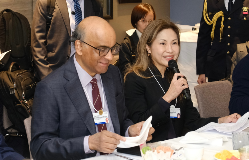
At the Philanthropy Asia Summit (PAS) 2026, Shamina Singh, President of the Mastercard Center for Inclusive Growth, put philanthropic capital in context.
"It [philanthropic capital] is the part of the stack that bears the most risk," she said. "Philanthropy can test programmes. Philanthropy can fund capacity-building efforts. Philanthropy can go towards the research."
By absorbing early-stage uncertainty, philanthropic capital creates the conditions under which larger pools of public or private funding are eventually prepared to act. Proof of concept, validated by independent research, is what makes scale legible to the actors who come next.
What the next three years will test
Anticipated outcomes fall across three areas. Knowledge and ecosystem building will strengthen the regional evidence base on small business growth and tech for good, while expanding alignment among policymakers, financial institutions and philanthropic actors. Capital mobilisation will direct funding toward testing scalable models that support small businesses, strengthen financial resilience and improve participation in digital and financial ecosystems. Market and policy influence will translate findings into adopted practice, inform policy discussions and strengthen governance in AI-enabled systems.
The objective, in each area, is to ensure that no insight capable of improving lives at scale sits unused for want of a funded pathway to test it.
Singh added: "The Center has developed a really good process for developing the evidence base, using research to build programmes on top of. This new partnership is about ensuring that evidence base moves to action, and that the research the Center has become known for producing, in partnership with the work of PAA, will achieve a bigger impact."
WATCH: Hear what Shamina Singh had to say about the collaboration at PAS 2026.








.tmb-.gif?Culture=en&sfvrsn=e13997ec_1)
.tmb-.gif?Culture=en&sfvrsn=b5ece239_1)
.tmb-.gif?Culture=en&sfvrsn=6fb3b6df_1)
.tmb-.png?Culture=en&sfvrsn=7fea9931_1)
.tmb-.gif?Culture=en&sfvrsn=3f4b1163_1)
.tmb-.jpg?Culture=en&sfvrsn=fedc60fc_1)