Currently reading
Sustainable Rice in Indonesia: Reaching Mainstream Shelves Without a Green Premium
Share to
Insights / Reports / Sustainable Rice in Indonesia: Reaching Mainstream Shelves Without a Green Premium

Sustainable Rice in Indonesia: Reaching Mainstream Shelves Without a Green Premium

15 Oct 2026
sticky-image--desktop


Indonesian farmers can grow rice with less water and lower methane emissions while holding yields steady. Field trials have settled that question. Whether sustainable rice in Indonesia reaches mainstream shelves now depends on the commercial system around the farm. The two conditions that matter most are a buyer committed before planting and a price that rewards better grain within the country’s regulated retail market.


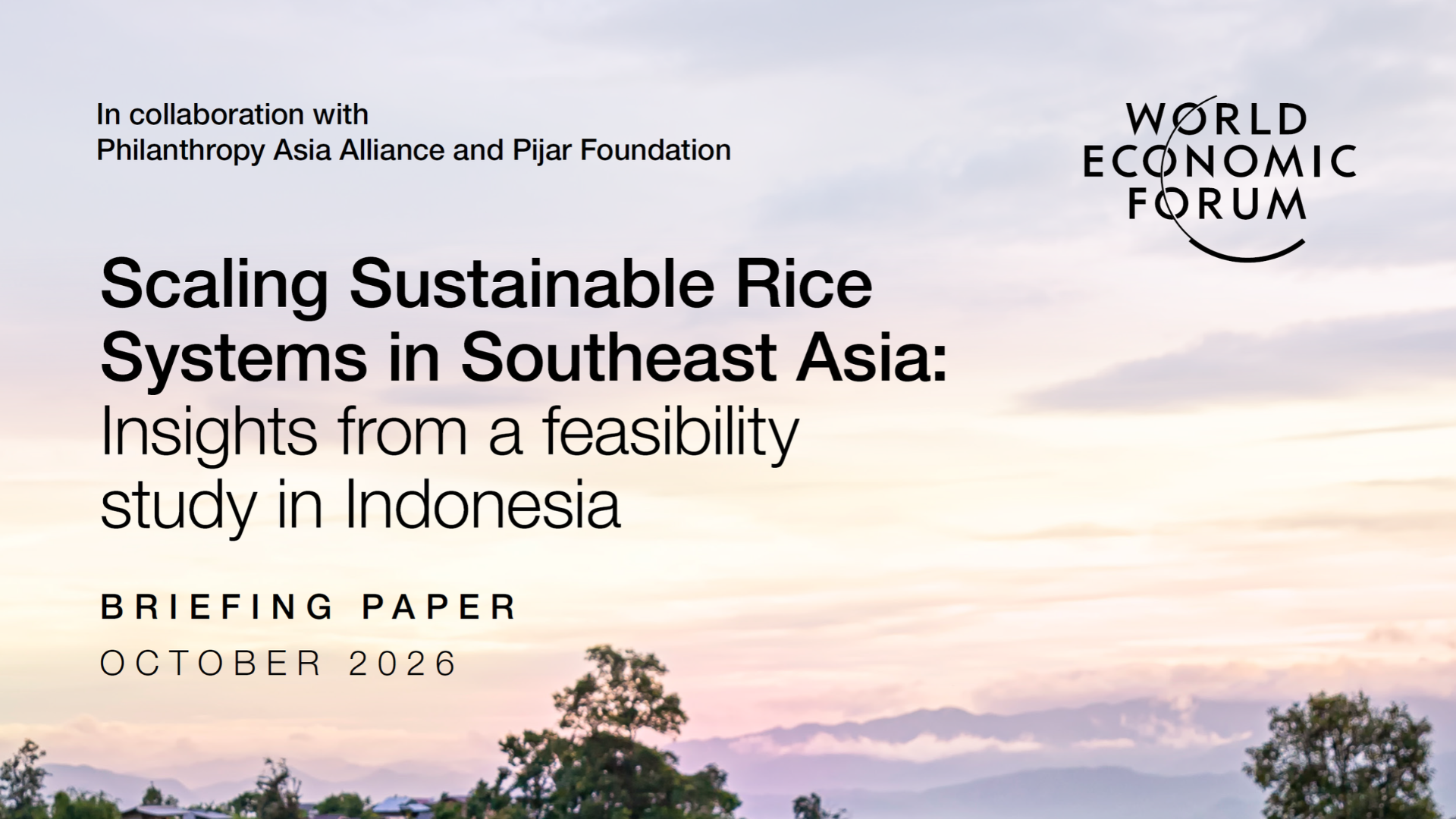
Scaling Sustainable Rice Systems in Southeast Asia, a briefing paper by Philanthropy Asia Alliance and Pijar Foundation in collaboration with the World Economic Forum, sets out how that system could work. A 2026 feasibility study underpins the analysis, covering farm-level economics and the wider market from credit and inputs through to milling and retail. In Indonesia the question is a matter of national policy. Rice feeds more than 250 million people, and food self-sufficiency, or swasembada pangan, is a flagship government priority. Paddy cultivation also produces about 34% of the country’s agricultural greenhouse gas emissions. Its modelled pathway runs from a 100-hectare trial to a 10,000-hectare portfolio reaching about 40,000 smallholder farmers.


What Is Alternate Wetting and Drying?


Alternate wetting and drying (AWD) is a rice-growing practice in which farmers let fields dry to a safe threshold before flooding them again, in place of keeping paddies submerged all season. Under Indonesian conditions, AWD has held yields steady while cutting irrigation water use by up to 30% and methane emissions by up to 35%. Much of that evidence comes from the completed agronomic trial in Grobogan, Central Java, led by Temasek Life Sciences Laboratory with support from Philanthropy Asia Alliance. Philanthropic funding at that stage paid to establish that AWD works locally, the proof buyers and lenders look for before they commit capital. The method performs best alongside certified seed and more efficient fertiliser use. Its results also serve a national goal, the Low Carbon Development Initiative target of bringing about one million hectares into low-carbon cultivation by 2030.


How Sustainable Rice Earns More Within Indonesia’s Regulated Prices


Indonesia caps retail rice prices through the Harga Eceran Tertinggi (HET) system, which sets separate maximums for regular and premium grades. The upper tier rewards grain quality and carries no sustainability label. AWD-grown harvests could qualify for it with better kernels and higher milling recovery. Under the modelled scenario, farmer net surplus climbs about 31%, driven by a stronger farmgate return, a yield gain of about 6% and slightly lower total costs. Offtakers, the millers and traders who buy the paddy, benefit because that higher class sells for more than the extra they hand to growers, lifting their gross processing margin by an estimated 45%. Shoppers pay an existing regulated rate, with no surcharge for climate credentials. Grounding the economics in production fundamentals suits most mainstream markets, where few consumers will spend more on environmental grounds. A proposed 100-hectare commercial trial, the Entry Cohort, would test these assumptions in real operating conditions.


Why Committed Buyer Demand Comes Before Farmer Adoption


Farmers adopt a new practice more readily once the harvest has a committed purchaser, and that commitment gives lenders a reason to extend working capital. For the first 100 hectares, the report proposes a single champion offtaker to anchor demand, with a pooled arrangement across several firms held in reserve for scale. The First Movers Coalition for Food, a World Economic Forum initiative with more than 60 partners, describes two procurement routes that avoid a green premium. Spec-anchored sourcing writes climate and water requirements into supplier specifications and contracts. Decoupled sourcing separates the sustainability investment from the physical purchase. Buyers fund programmes within a supply-shed, the area their grain comes from, while growers stay free to sell on the open market, and each one claims outcomes in line with the volume it takes, a method called mass balance. For companies with Scope 3 targets, both models rest on monitoring, reporting and verification (MRV) systems that trace every consignment back to the paddy.


Where Philanthropic Capital Lowers Risk on the Path to Scale


Many rice farmers in Indonesia sell their crop to middlemen in advance at a discount, in exchange for upfront money, leaving little to fall back on if a harvest fails while they learn a new method. In the Entry Cohort, philanthropy carries the earliest risk, funding agronomy training and a first-loss reserve, a buffer that takes losses ahead of any creditor and refills from repayments over time. The model assumes working capital at about 3%, which more than offsets the extra labour and monitoring AWD requires. Delivery runs through Gapoktan, the country’s established network of producer groups, where trained members teach their peers. If the trial meets its criteria across its two-year run, the programme would expand to a modelled 10,000-hectare portfolio reaching about 40,000 smallholders. Development finance institutions and multilateral lenders would then take on more of the credit, with commercial banks following. Carbon revenue plays no part in the core case, since a payback of three to four years after registration is too long for households without savings to rely on.

With the agronomy established, the open questions are commercial. One is whether AWD-grown grain can meet the premium standard across successive crops. Another is the timing of buyer commitment, which needs to come before farmers change how they grow. If both hold, sustainable rice in Indonesia can reach mainstream shelves on its own economics, and other producing countries with similar price rules can adapt the model to their markets. Procurement teams weighing an offtake agreement, and funders deciding where early capital does the most, will find the full farmer and offtaker figures and financing design in the report.


Further Reading

12 Aug 2026
Ending Mosquito-Borne Diseases: Why the Funding Model Has to Catch Up With the Science

Mosquito-borne disease prevention across Asia needs coordinated funding. PAA, Temasek Foundation and Temasek Life Sciences Laboratory map the gaps and propose a philanthropic-led response.

18 May 2026
Philanthropy as Risk Capital in Asia: How the Region's Funders Back the Unproven

A study of how Asian philanthropists fund the earliest stages of social innovation, drawing on ten cases reaching 210 million people across 13 economies.

16 May 2026
Collective Action for People, Planet, Ocean, and Health

As global conditions shift, collaborative philanthropy in Asia is reorganising. PAA's 2026 Impact Report shows how Communities are driving systemic action.

21 Jul 2025
PAS 2025 Insights Report – Priming Asia for Good: Catalysing Action for Impact

Dive into key takeaways from the fifth edition of PAA’s flagship philanthropy convening. This report explores bold solutions, catalytic partnerships, and actionable takeaways to drive Asia towards a more inclusive, sustainable future.

06 May 2025
New Report Calls for Collective Action to Combat Asia’s Growing Antimicrobial Resistance Threat

A new report by CIIP and GAEA, supported by PAA, highlights the urgent AMR threat in Asia and calls for cross-sector investment to drive high-impact action across education, prevention, surveillance, and treatment.

02 May 2025
Seeding a Hopeful Future: PAA Impact Report 2025

PAA's inaugural Impact Report highlights our progress since launch, showing how collaboration across public, private, and philanthropic sectors is driving meaningful change across Asia’s most urgent challenges.

21 Nov 2024
Seeding the Future: Transforming Smallholder Farms for a Sustainable Tomorrow

Explore how sustainable solutions and innovative capital can strengthen Southeast Asia’s fragile agri-food system, meeting rising food demand while improving smallholder livelihoods and long-term food security.

16 Aug 2024
PAS 2024 Insights Report – Partnerships for Impact: A Roadmap on Collaboration to Catalyse Climate, Education, and Health Action in Asia

Uncover transformative insights and key takeaways from global action and thought leaders across public, private, and philanthropic sectors at the Philanthropy Asia Summit (PAS) 2024.

03 Dec 2023
Catalysing Climate Action in Asia: Unlocking the Power of Philanthropic-Private-Public Partnerships

The first Asia-focused climate philanthropy report by the World Economic Forum’s Giving to Amplify Earth Action (GAEA) initiative, in collaboration with PAA and ClimateWorks Foundation, examines state of climate philanthropy in Asia.